Lifting Thin Precast Carbon Concrete Elements
A solution for lifting particularly thin precast concrete elements with a shallow embedment depth.
Your project.
Our solution.
Every project has its own requirements. Our experts will help you find the right technical solution.
Initial situation and requirements
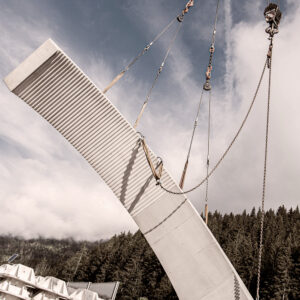
The Franklin Footbridge in Mannheim is a pedestrian and bicycle bridge approximately 45 meters long that spans the B 38 and is considered the world’s longest integral wooden bridge, i.e., a structure consisting of intricately block-glued wooden beams and carbon-fiber-reinforced concrete slabs mounted on a steel framework. A total of 32 concrete slabs for the bridge deck were to be equipped with a custom-designed transport anchoring solution.
The challenge with the tread plates was not their size (approx. 5.15 x 1.4 m) or weight (approx. 1.8 t), but rather their thinness and conical shape.
The tread plates taper from the center, from approximately 12 cm to just 8 cm. In addition, they are reinforced with a symmetrical, bidirectional carbon fiber composite grid.
Our solution and implementation
- Use of four short RD 16 stainless steel flat steel anchors with a shallow embedment depth
- Solution without additional reinforcement using rebar
- No contact between steel and concrete
- Load Distribution During Lifting and Installation Operations Using Balancing Slings
Given the thin panel thickness, a suitable solution was selected from the PHILIPP transport anchor portfolio: four short stainless steel flat steel anchors, model RD 16. The anchors are 36 mm high and have a plate measuring 60 × 60 × 5 mm. During lifting and installation, a load-balancing sling ensures that all four anchors are loaded evenly. This guarantees safe handling of the plates even with a shallow embedment depth.
Normally, RD 16 flat steel anchors require, in addition to the minimum reinforcement in the form of a Q257A reinforcing steel mat, double back-hang reinforcement above the anchor plate. For the oblique tension load case, an additional stirrup is also required. Since the mesh reinforcement was replaced here with a carbon fiber reinforcement and the top-tie and diagonal tension reinforcement had to be omitted, preliminary tests were conducted on comparable concrete specimens at the Oschatz concrete plant. This confirmed the performance of the flat steel anchors even without additional reinforcement.
The panels were successfully installed on the wood-steel structure in September 2025 and put into operation shortly thereafter.
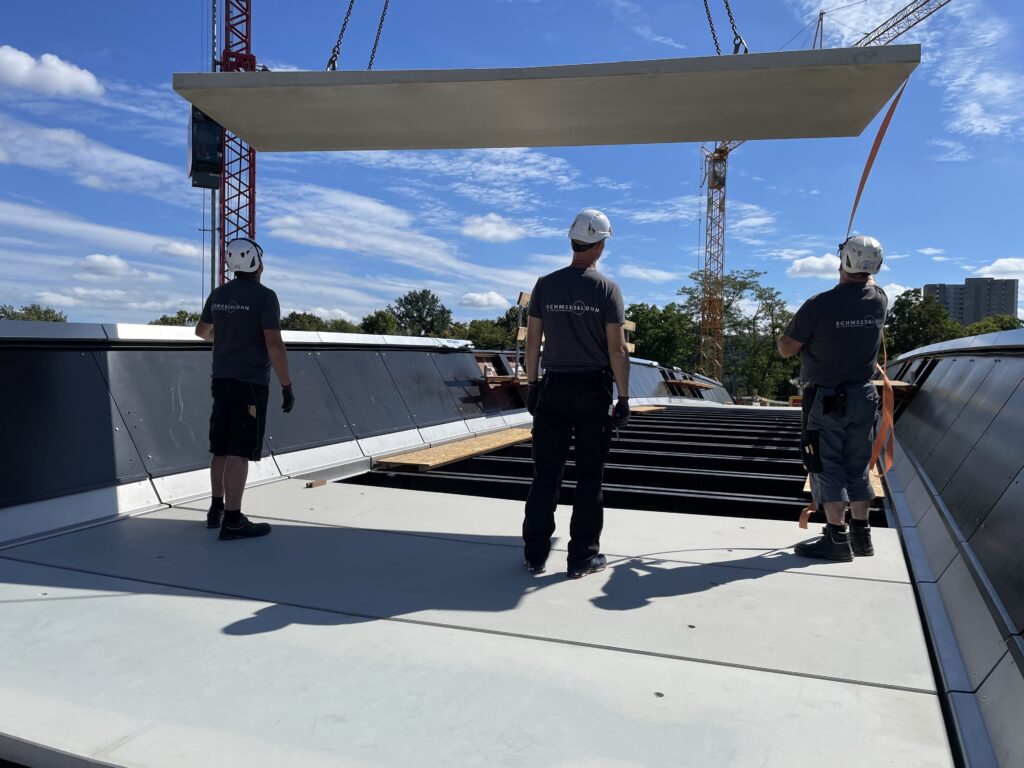
The concrete slabs for the bridge deck were equipped with a custom-designed transport anchoring system.
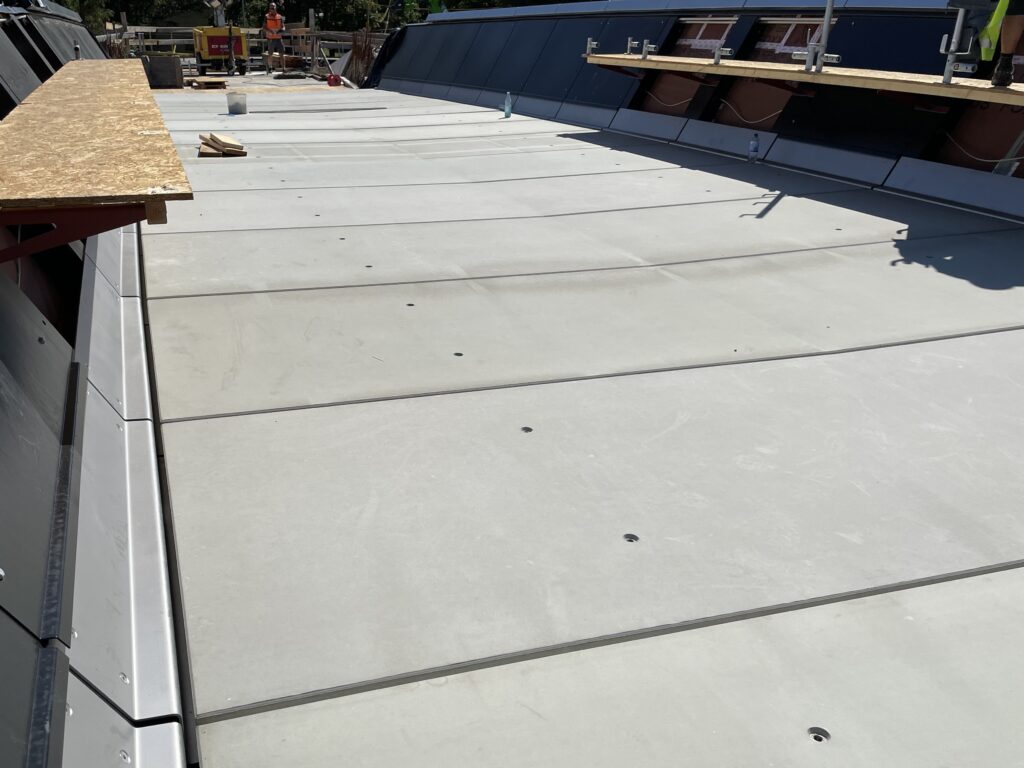
Installation of a total of 32 concrete slabs onto the existing wooden bridge structure.